.
.





Forming an LLC in Ohio starts with choosing an available name, appointing an Ohio statutory agent, and filing articles of organization (Form 610) with the Ohio Secretary of State. The state filing fee is $99. Ohio does not require a domestic LLC to file an annual or biennial report, but you still need to keep your statutory agent information current and handle any tax, licensing, employer, and other obligations that apply to your business.
Key takeaways
- Choose a distinguishable Ohio LLC name that follows the state's naming rules; reserving the name is optional.
- Appoint and maintain an Ohio statutory agent—Ohio uses this term instead of "registered agent"—and the agent's information must stay current.
- File articles of organization (Form 610) with the Ohio Secretary of State and pay the $99 filing fee.
- An operating agreement can document ownership and management. After formation, determine whether you need an employer identification number (EIN) and consider a separate business bank account.
- Ohio does not require a domestic LLC to file an annual or biennial report or issue a catch-all business license, but tax, employer, and licensing obligations depend on the business' activity, receipts, location, and workers.
Step 1: Name your Ohio LLC
Ohio requires an LLC name to be distinguishable under the state's naming rules and to include an approved limited liability designator. Checking the name early can help prevent a filing delay. Use LegalZoom’s free Ohio business name search tool to see if your preferred business name is available for use. Be sure to check for close variations of your preferred name, too. Your business name must be unique and distinguishable from other names registered with the state.
Free Ohio Business Name Check
Starting a business? Use our free name check tool to check your business name against the Ohio Secretary of State records.
By clicking "Check Availability," I agree to LegalZoom's Terms of Use. This search is a preliminary check of state databases and does not include variations or trademarks. Results do not guarantee name availability or compliance with legal requirements.
What naming rules does Ohio require for LLCs?
Ohio permits designators such as "Limited Liability Company," "LLC," "L.L.C.," "Limited," and "Ltd." in an LLC name.
The name must be distinguishable from the entities and names already registered in the state. Ohio also restricts names that suggest a government affiliation and may require approval for terms such as "bank," "banker," "banking," or "trust." A different word order can distinguish a name, but punctuation, symbols, abbreviations, and entity designators generally do not. Check the full name against the Secretary of State's guidance.
How long does an Ohio LLC name reservation last, and what does it cost?
To reserve a name before filing, submit Form 534B to the Secretary of State. The reservation lasts 180 days, and the fee is $39. You can file online through the Business Filings portal or by mail. At the end of the 180 days, you’ll need to register your business if you want to secure the name. You can’t renew your business name reservation.
Should you secure a matching domain and email address?
Once the state name search looks clear, check matching domain and business email availability, as there’s a chance somebody outside the state has already claimed it. Ohio name approval only addresses the state's entity records. It does not establish federal trademark rights or guarantee that a domain is available. Run a trademark search before investing in a brand.
Step 2: Appoint an Ohio statutory agent
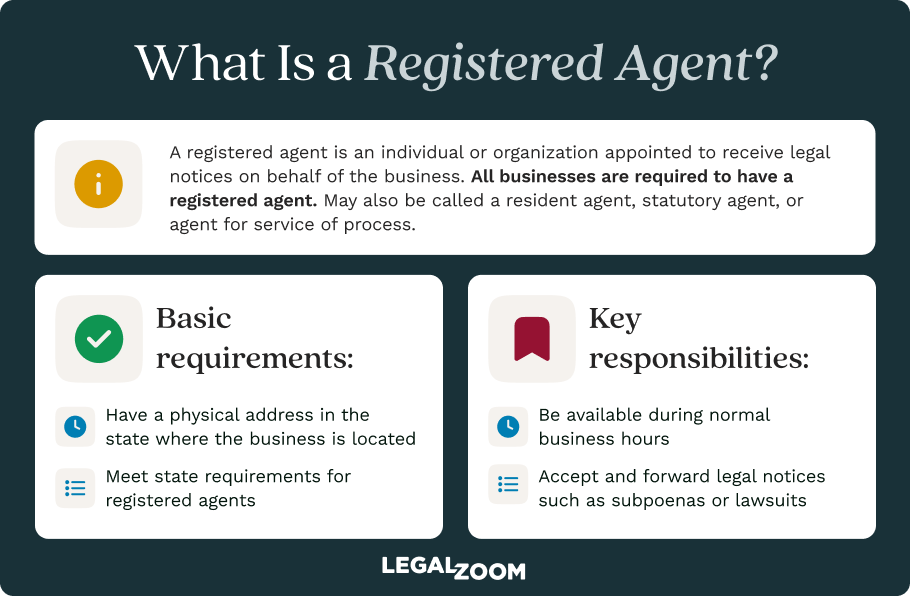
Ohio requires every domestic LLC to keep a statutory agent on file from formation. The agent accepts service of process and other official notices. Ohio uses “statutory agent” rather than “registered agent,” and getting the term right matters on state forms. You can act as your own statutory agent if you meet the requirements, but you may want to work with a dedicated Ohio statutory agent service.
Who can serve as a statutory agent in Ohio?
Your statutory agent must meet Ohio’s guidelines—if they qualify, they can serve.
- You or a trusted individual who is an an Ohio resident with a physical street address in the state
- Another LLC member, under the same residency rule
- A professional statutory agent service, which puts its own business address on the public record instead of yours
The agent needs an Ohio street address where service and other notices can be received during business hours. P.O. boxes and commercial mail receiving agency (CMRA) do not qualify.
What happens if your Ohio LLC doesn't maintain a statutory agent?
If your Ohio LLC does not maintain a statutory agent, the Secretary of State sends notice by ordinary or electronic mail to the company's email address on file, or to the address specified in a statutory-agent resignation notice. If you do not correct the problem within 30 days, the state may cancel the LLC's articles. Keep the agent information current and respond to notices promptly so you can use the statutory cure and reinstatement process if needed.
Does a statutory agent service protect your home address?
The agent's name and address are part of the Secretary of State's public business record. Using a commercial statutory agent service may keep your home address out of the agent listing, but it does not make the entire LLC record private.
Step 3: File your Ohio articles of organization (Form 610)
Once your name and agent information are ready, file Form 610 with the Ohio Secretary of State and pay the $99 filing fee. Ohio law forms the LLC when the articles are filed, unless the articles specify a later effective date or time.
You’ll need to complete the fields the form requests, including the LLC's name, statutory agent information, agent acceptance, and organizer signatures. The form also includes optional provisions such as an effective date and time and a purpose clause. Access the form through the Ohio Business Filings portal or download the paper form for mail or in-person filing. Compare the name, agent information, signatures, payment, and effective-date instructions with the form before submitting.
Can you file online, by mail, or in person?
You can file in three different ways.
- Online. File through the Ohio Business Filings portal at bsportal.ohiosos.gov. This is the fastest option.
- By mail. You can mail your documents with a check or money order made payable to “Ohio Secretary of State” to Ohio Secretary of State, P.O. Box 670, Columbus, OH 43216; expedited mail: P.O. Box 1390, Columbus, OH 43216
- In person. You can deliver your documents in person to the Client Service Center, 180 Civic Center Drive, Columbus, OH 43215. The office is open Monday through Friday from 8 a.m. to 5 p.m.
How long does processing take, and are expedited options available?
Standard processing times can change, so check the Secretary of State's current turnaround information when you file. Expedited processing is available for additional fees when the cutoff and submission requirements are met; the fee table below lists the expedited tiers.
Step 4: Create an Ohio LLC operating agreement
An operating agreement explains how the LLC will be owned and managed, including contributions, distributions, voting, and decision-making. Ohio does not require you to file the agreement with the Secretary of State, but a written agreement can set the rules you choose instead of leaving every unanswered issue to Ohio's default rules.
What should a single-member LLC's operating agreement include?
Ohio Revised Code § 1706.01(R) recognizes a single-member operating agreement as a written declaration from the sole member. Use it to record ownership, contributions, distributions, management authority, records, transfers, and dissolution plans. Ohio law does not make a single-member agreement unenforceable simply because it has one party. Keep the signed agreement with the LLC's formation records.
Step 5: Get an EIN and open a business bank account
An employer identification number, also known as an EIN, is a federal tax ID issued by the IRS. A multi-member LLC generally needs one, as does an LLC with employees or certain excise tax obligations. A single-member LLC treated as a disregarded entity may not need an EIN for federal income tax purposes, but it may still obtain one for banking or state tax purposes. Apply directly through the IRS or use LegalZoom’s EIN service to manage the application on your behalf.
Should you open a separate business bank account?
A separate business bank account helps keep business and personal records distinct and simplifies bookkeeping, taxes, and future financing. It is a sound recordkeeping practice, but no single banking practice guarantees how a court will evaluate liability. Banks commonly ask for the accepted articles of organization, EIN, and sometimes the operating agreement.
Step 6: Register for Ohio state taxes and employer obligations
Ohio tax and employer obligations depend on what the LLC sells, its receipts, its location, and whether it has workers. The Ohio Business Gateway is used for many registrations, but check the relevant agency and local government requirements for your business.
Does your LLC need to collect sales tax?
If you sell taxable goods or taxable services, you may need a vendor's license, and you must collect sales tax. Ohio's state sales tax rate is 5.75%, and local and transit additions can bring the combined rate as high as 8.75%.
Ohio retains origin sourcing for most sales of tangible personal property made by Ohio vendors to Ohio consumers, while marketplace facilitators use destination sourcing. Other transactions may follow different rules, so check the Department of Taxation's rate and sourcing guidance when setting prices or configuring a point-of-sale system.
What is the Commercial Activity Tax (CAT)?
The CAT applies to Ohio taxable gross receipts rather than profit. The exclusion is $6 million. The CAT rate is 0.26% on taxable gross receipts above the exclusion. A business that exceeds the threshold generally must register within 30 days, and active CAT accounts file quarterly. Confirm requirements with the Department of Taxation.
Do you need to register as an employer?
If your LLC hires workers, review Ohio withholding, unemployment, new-hire reporting, and workers' compensation requirements. These obligations vary by the business and workforce.
- Register online through OH|TAX eServices for an Ohio employer withholding account within 15 days after withholding liability begins
- Register with the Ohio Department of Job and Family Services for unemployment compensation at jfs.ohio.gov
- Report each new hire through Ohio's New Hire Reporting system
- Review Ohio workers' compensation requirements
Check the instructions from the Department of Taxation, the Ohio Department of Job and Family Services, Ohio New Hire Reporting, and the Bureau of Workers' Compensation. School district withholding can depend on the employee's residence and local rules, so verify it rather than assuming one example applies to every worker.
Building a business is enough work as it is. We'll help you start your LLC with confidence.

Step 7: Check if your Ohio LLC needs a business or vendor's license
Ohio does not issue a catch-all business license. Your requirements depend on what you sell, where you operate, and whether a state licensing board regulates your industry. Check state, county, city, and professional requirements before you start operations. LegalZoom’s business license report can help you figure out which licenses your business needs.
Does every Ohio LLC need a vendor's license?
A business that sells tangible personal property or certain taxable services may need a vendor's license. You can register through OH|TAX eServices, which issues the license immediately, or through the county auditor. The appropriate process depends on the license type. A new vendor's license costs $50, and the requirements for fixed-location, transient, and out-of-state sellers differ.
What other licenses might your business need?
Requirements can come from state professional boards, local governments, or federal agencies for regulated industries. Contractors, cosmetologists, barbers, alcohol sellers, and other businesses may need additional approvals. Use Ohio's business-starting roadmap and check the city or county where the LLC operates.
Ohio LLC costs: filing and ongoing costs
| Cost item | Amount | When it applies |
|---|---|---|
| Articles of organization (Form 610) filing fee |
$99 | Every Ohio LLC, at filing |
| Name reservation (Form 534B) |
$39 | To hold a name before filing |
| 2-business-day expedite | $100 | Faster-than-standard processing |
| 1-business-day expedite | $200 | Next-business-day approval |
| 4-hour expedite | $300 | Four-hour processing if received by 1 p.m. |
| Vendor's license | $50 for a new license; other fees may apply | If you sell taxable goods or services |
| Commercial Activity Tax | $0 up to the $6 million exclusion | Only if Ohio taxable gross receipts exceed the CAT threshold |
Ohio does not charge an annual or biennial LLC report fee for a domestic LLC. Your budget may still include a professional statutory agent service, applicable CAT, vendor's license or sales tax costs, tax and employer filings, trade name or local license renewals, and other activity-based expenses. Keep a calendar for these obligations rather than assuming that no annual report means no ongoing work. See LegalZoom's full breakdown of Ohio LLC costs.
The risks of filing your Ohio LLC on your own
Filing an Ohio LLC yourself is possible, but a mistake in the formation paperwork or an overlooked follow-up obligation can create avoidable costs and compliance problems. Common DIY risks include the following.
- A state business name search does not clear federal trademark rights. Choosing a name that conflicts with an existing trademark can create rebranding problems after you invest in the business.
- Errors on Form 610 can delay formation or add expedited-processing costs. Check the LLC name, statutory-agent information, signatures, payment, and effective-date instructions before submitting.
- Choosing an ineligible statutory agent or failing to update the agent's information can lead to missed notices and put the LLC at risk of cancellation. Confirm the agent's Ohio street address and acceptance, and update the information when it changes.
- Treating Ohio tax, license, and employer rules as one-size-fits-all can lead to missed registrations or filings. Check requirements based on the business' activity, receipts, location, and workers.
- Assuming that no annual report means no ongoing compliance work can leave an LLC unprepared for recurring tax, license, employer, or local renewal obligations. Keep a calendar for the requirements that apply to the business.
How to start your Ohio LLC with LegalZoom
Filing Form 610 yourself is entirely doable. But, if you’d rather hand off the paperwork, LegalZoom’s Ohio LLC formation service can help prepare and file your articles of organization with the Ohio Secretary of State.
LegalZoom can also help with:
- Statutory agent service, which can help keep your home address off the public record.
- Operating agreement drafting to document your LLC’s ownership and management structure.
- EIN support after your LLC is formed.
Ohio LLC FAQs
Can a non-Ohio resident form an Ohio LLC?
Yes. Ohio law allows one or more persons to form an LLC, so the owner or organizer does not have to live in Ohio. The LLC must still appoint a qualifying Ohio statutory agent; an LLC formed in another state that transacts business in Ohio may instead need to register as a foreign LLC.
How do you change an Ohio LLC's name after formation?
File a certificate of amendment or restatement (Form 611) with the Ohio Secretary of State and pay the $50 filing fee. Check the new name against Ohio's availability rules before filing. The amendment changes the articles but does not change the LLC's original effective date. See the Secretary of State's filing forms and fee schedule.
How do you dissolve an Ohio LLC?
Follow the LLC's governing documents, wind up its business and obligations, and file a certificate of dissolution (Form 616) with the Ohio Secretary of State. The filing fee is $50. Ohio's closing guidance says dissolution can also require updates with the Department of Taxation and, depending on the business, the Bureau of Workers' Compensation, Ohio Unemployment Compensation, and other agencies. Review the state's dissolution guidance and LLC filing forms and fees before closing.
Does Ohio allow a series LLC?
Yes. Ohio law permits designated asset series through an operating agreement. Liability separation requires separate records and required statements in the operating agreement and articles. See Ohio Revised Code § 1706.76 and § 1706.761. Because series structures are complex, consider professional advice.
How do you change an Ohio LLC's statutory agent?
File a Statutory Agent Update (Form 521) with the Ohio Secretary of State. The fee schedule lists a $25 fee, and the form can be submitted online or by paper filing. Keep the agent's name, Ohio street address, and contact information current so the LLC can receive service of process and state notices. See the Secretary of State's filing forms and fee schedule.
Does an Ohio LLC need a certificate of good standing?
Ohio does not require one as part of the LLC formation filing. The document, also called a full force and effect certificate, shows that the business is current with required Secretary of State filings. A bank, lender, contract party, or another state may request it, and you can purchase one through the Ohio Secretary of State's certificate portal.
Does Ohio require an LLC to publish a notice of formation?
No general newspaper publication step is required for a new Ohio domestic LLC.
'%20/%3e%3c/svg%3e)

'%3e%3cpath%20fill-rule='evenodd'%20clip-rule='evenodd'%20d='M9.31239%2025.5316H13.0679V14.1032H9.31239V25.5316ZM11.1913%208.46875C9.93945%208.46875%209%209.25086%209%2010.505C9%2011.5995%209.78211%2012.5389%2011.1913%2012.5389C12.6005%2012.5389%2013.3826%2011.5995%2013.3826%2010.505C13.3826%209.4082%2012.6005%208.46875%2011.1913%208.46875ZM27%2018.9577V25.5316H23.2445V19.4275C23.2445%2017.8609%2022.6174%2016.7664%2021.3679%2016.7664C20.2711%2016.7664%2019.644%2017.5463%2019.3316%2018.1756C19.1743%2018.488%2019.1743%2018.8004%2019.1743%2019.1128V25.5316H15.4165V13.9458H19.1743V15.5123C19.644%2014.7302%2020.5835%2013.6357%2022.6174%2013.6357C25.1234%2013.7908%2027%2015.3573%2027%2018.9577Z'%20fill='white'/%3e%3c/g%3e%3cdefs%3e%3cclipPath%20id='clip0_952_9489'%3e%3crect%20width='18'%20height='18'%20fill='white'%20transform='translate(9%208)'/%3e%3c/clipPath%3e%3c/defs%3e%3c/svg%3e)